B2B content marketing is the practice of creating and distributing useful content, articles, reports, webinars, talks, and tools, to attract and convert other businesses into customers. Rather than pitching a product head-on, you publish material that helps the buyer do their job. Over a long, multi-person buying cycle, that builds the trust and visibility that eventually turns into pipeline. The point is not to entertain. It is to be the company a buyer already trusts by the time they are ready to buy.
Content marketing means earning a buyer's attention by being useful instead of buying their attention with ads. In B2B, that usefulness has to survive scrutiny from a committee, not just catch one person's eye. A VP forwards your report to a director, who forwards it to an analyst, who checks your math. Content that holds up at every step is content that moves a deal.
So B2B content is rarely about a clever tagline. It is about answering the real questions a buyer has at each stage: what is this category, which vendor fits my situation, what will this cost, what goes wrong, and how do I justify the spend to my boss. Map your content to those questions and you have a strategy. Skip them and you have a blog nobody reads.
The gap between B2B and B2C content comes down to who buys and how. B2C is often one person making a fast, emotional call. B2B is a buying committee of 6 to 10 people making a slow, defensible one, sometimes over several months.
That changes everything about the content. Here is the practical contrast:
| Factor | B2B content | B2C content |
|---|---|---|
| Decision makers | 6 to 10 people on a committee | Usually one person |
| Buying cycle | Weeks to many months | Minutes to days |
| What persuades | ROI, proof, risk reduction | Emotion, identity, convenience |
| Best formats | Reports, case studies, webinars, talks | Short video, social, ads |
| Audience size | Smaller, high value per account | Large, lower value per buyer |
| Success metric | Pipeline and influenced revenue | Reach, conversions, sales velocity |
The audience-size row matters more than people expect. A B2C brand can chase millions of impressions. A B2B company selling to 2,000 target accounts does not need reach. It needs the right 200 people to read one excellent report. That single constraint reshapes how you write, what you publish, and how you measure.
The clearest way to understand B2B content marketing is to look at companies doing it well:
Notice what these have in common. None of them lead with the product. They lead with something the buyer wants for its own sake, then let the brand association do the selling. That is the whole trick.
You do not need every format. You need one or two you can produce consistently, plus a signature asset that makes you worth citing. The reliable workhorses:
The SEO blog. Articles that rank for the problems your buyers search. Slow to ramp, usually 6 to 12 months, but it compounds. A page you wrote this spring keeps producing leads two years from now at no extra cost.
The signature report. Original research or a benchmark study people quote. This is the highest-return B2B content there is, because every citation is a free, credible mention from someone else's mouth.
Webinars and case studies. Mid-funnel content for buyers who already know the category and want proof. Case studies in particular do the work sales reps cannot: they let a prospect see a peer who succeeded with you.
Conference talks and sessions. Live content, delivered to a room of buyers who chose to learn about your topic. We will come back to why this is some of the most underrated content marketing in B2B.
A conference session is content marketing delivered live. The mechanics are the same as a blog post: teach the audience something useful, and let your brand get the credit for the answer. The difference is distribution. Instead of hoping the right buyer finds your article, the conference hands you a room of people who already raised their hand for your topic.
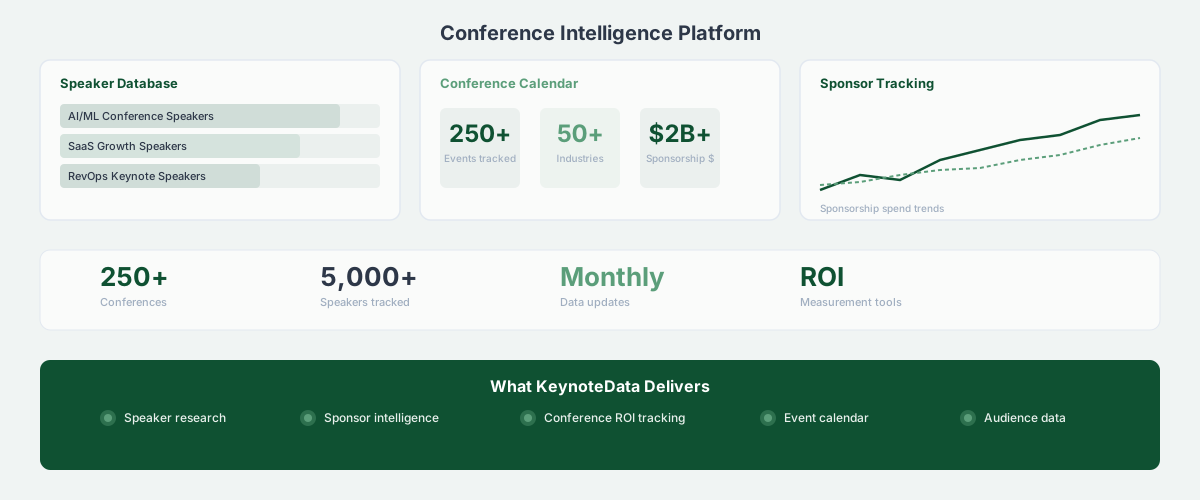
That makes a strong talk one of the highest-ROI content formats in B2B, if you pick the right event. A session at the wrong conference reaches the wrong audience, no matter how good the talk is. The reliable signal of who attends is who speaks. If companies from your target account list send speakers to an event, their broader teams are in the building. Our conference marketing strategy guide covers how to turn that into pipeline, and the speaker database lets you check which accounts show up where before you commit budget.
Repurposing closes the loop. A single conference talk becomes a blog post, a webinar replay, a LinkedIn carousel, and three weeks of social clips. One hour on stage can feed a quarter of content if you plan the capture in advance.
Vanity metrics will lie to you. Page views, impressions, and downloads feel like progress, but a CFO does not fund traffic. Tie content to the same scoreboard the rest of marketing uses:
The honest read on content is patient money. It costs more than it returns for the first two or three quarters, then the curve bends as ranking pages and cited reports keep producing leads without fresh spend. Judge it on a 12-month horizon, not a 30-day one, or you will kill a program right before it pays off.
A working B2B content strategy is not complicated, it is just disciplined. Know your ICP and the problems they search. Pick one or two formats you can sustain. Build a signature asset worth citing. Distribute across search, email, social, and events. Measure against pipeline, not page views. Then give it a year.
The companies that win at content are not the ones with the biggest budgets. They are the ones who picked a lane, published consistently, and let the work compound while competitors chased the next channel. The question is not whether content marketing works in B2B. It is whether you will stay in it long enough to see the curve bend.
A preview of the speaker intelligence behind smarter event content.
| Name | Title | Company | Level | Conference(s) | |
|---|---|---|---|---|---|
| Yamini Rangan | CEO | HubSpot | C-Level | INBOUND,SaaStr Annual | LinkedIn ↗ |
| Kerry Cunningham | Head of Research & Thought Leadership | 6sense | Head of | INBOUND,6sense Breakthrough | LinkedIn ↗ |
| Olivier Godement | Head of Platform | OpenAI | Head of | INBOUND,Dreamforce | LinkedIn ↗ |
Showing 3 of 887 speakers. Get full access to filter and export by account and seniority.
887 speakers, 487 sponsors, 13 conferences. See which accounts show up where, then put your content in front of them.