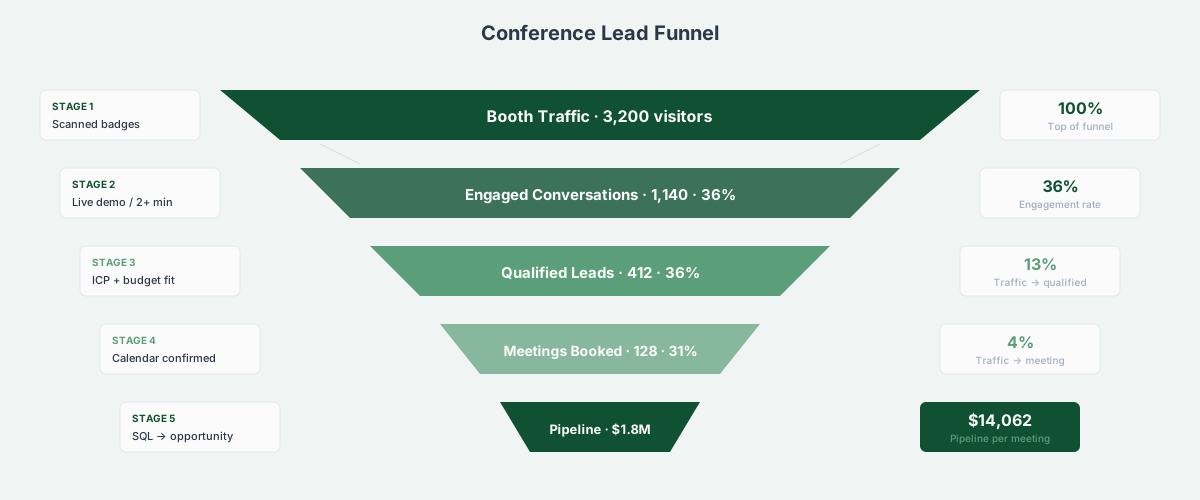
Trade shows and B2B conferences consume a massive share of marketing budgets. The average company spends $40,000-$80,000 per event when you factor in everything. And most of that investment produces a spreadsheet of badge scans that goes nowhere. The problem is the approach. Lead generation at trade shows works when you treat it like a structured campaign, not a fishing expedition.
The biggest mistake in trade show lead generation is treating the event itself as the starting point. By the time you're setting up your booth, the best opportunities are already booked. The companies that generate the most pipeline from conferences start working 8-12 weeks before the event.
Here's the pre-event lead generation sequence:
Weeks 8-10: Build the target list. Pull the speaker roster from the conference website. Identify every company with a speaker at the event. Cross-reference against your target account list. Then use sponsor data to add companies investing in the event as sponsors. These two lists combined give you the best available proxy for who's attending.
For conferences tracked by KeynoteData, the speaker database lets you filter by company, seniority, and event in seconds. For other events, you'll need to pull the roster manually from the event website.
Weeks 6-8: Start outreach. Send personalized connection requests on LinkedIn and direct emails to your target contacts. The message formula is simple: mention the conference, reference a shared interest or challenge, and propose a specific meeting time. "I see your team is presenting at SaaStr Annual. We help companies like yours solve [specific problem]. Worth 15 minutes during the conference?" Keep it short. Keep it specific. Conference-referenced outreach converts at 2-3x the rate of generic cold outreach because the conference provides a reason to meet.
Weeks 4-6: Book meetings. Convert interested responses into calendar holds. Block specific 15-30 minute slots during the conference. Morning coffee meetings before sessions start. Lunch meetings. Late-afternoon slots after the expo floor closes. The more meetings pre-booked, the less you depend on random booth traffic.
Week 1: Confirm everything. Send confirmation emails to all pre-booked meetings. Share your booth location and cell number. People forget. Conferences are overwhelming. A reminder the week before reduces no-shows by 30-40%.
Most booths are designed to look impressive. Very few are designed to generate conversations. Here's the difference.
Impressive booth: Large branded backdrop, product logos everywhere, multiple monitors showing demos on loop, a table full of swag. It looks professional. It also creates a wall between your team and attendees. People walk by, grab a sticker, and keep moving.
Conversation booth: Open layout with no barriers between your team and the aisle. A bold, provocative question displayed prominently ("Still forecasting pipeline in spreadsheets?"). Team members positioned in the aisle, not behind the counter. One focused demo station for deeper conversations. Minimal swag, maximum engagement.
The conversation booth generates fewer badge scans. It generates far more qualified meetings. That tradeoff is worth making every time.
Train every team member to open with a qualifying question, not a pitch. The question should identify whether the person has the problem you solve.
Examples:
If the answer reveals a relevant pain point, continue the conversation. If it doesn't, politely disengage. A 30-second qualifying question saves your team from spending 10 minutes on someone who will never buy.
The expo floor is one slice of the conference. The hallway, the session rooms, and the evening events are where some of the best lead generation happens.
Session targeting. Send team members to sessions directly relevant to your product category. The people in the room are self-selected: they've chosen to spend 45 minutes learning about a topic related to what you sell. After the session, approach people who asked questions or took notes. "What did you think about that session on ABM measurement? We've been working on exactly that problem" is a natural, non-salesy opener.
Speaker follow-up. Conference speakers are high-profile contacts. They're also the most approachable during the event itself. Attend their session, ask a thoughtful question, and introduce yourself afterward. Don't pitch. Build a relationship. Speakers at events like INBOUND, Dreamforce, and SaaStr Annual are typically senior leaders at your target accounts. A genuine connection is more valuable than a badge scan.
Evening and off-site events. Happy hours, dinners, and side events generate conversations that the expo floor can't. The environment is relaxed, there's no booth between you and the prospect, and the conversation tends to be more honest. If your conference sponsorship includes a private dinner or hospitality event, use it. If not, organize your own. A dinner for 10 target accounts costs $2,000-$5,000 and can produce more pipeline than a $15,000 booth.
Every qualified conversation needs to be captured immediately. Not at the end of the day. Not back at the hotel. During or immediately after the conversation.
Scan + notes. Scan the badge for structured data. Then immediately add notes: what the person cares about, what they asked, what pain point surfaced, and what the next step is. Use a shared Google Doc, a Slack channel, or a dedicated app. The format matters less than the speed.
Prioritize in real time. As conversations pile up, tag each one: hot, warm, or cold. Hot means there's a specific next step and the person matches your ICP. Warm means they showed interest but didn't commit. Cold means the conversation was surface-level or they don't match. This tagging drives your post-event follow-up tiers.
Enrich the data that night. At the end of each day, someone on the team should verify that captured leads have correct titles, companies, and LinkedIn profiles. Conference badge data is often sparse (name and company, sometimes just name). Enrichment fills in the gaps so your follow-up is accurate and targeted.
Conference leads have a half-life. The value of a lead drops rapidly after the event ends. Here's the follow-up cadence that captures the most value.
Within 24 hours: Tier 1 (hot) follow-up. Personal email from the team member who had the conversation. Reference a specific detail from the discussion. Propose a concrete next step: "Let's get that demo scheduled. How's Thursday at 2pm?" Include nothing else. No attachments, no pitch decks, no links. Just the next step.
Within 48 hours: Tier 2 (warm) follow-up. Semi-personalized email. "Great meeting you at SaaStr Annual. You mentioned you're exploring [specific topic]. Here's a resource we put together on that." Attach one piece of relevant content (a guide, a case study, or a benchmark report). Include a soft CTA: "If you'd like to dig deeper, happy to walk you through what we're seeing in this space."
Within 72 hours: Tier 3 (cold) follow-up. Add to a nurture sequence. These are not leads your sales team should call. They're marketing contacts who might become relevant later. Put them in a drip that delivers value over 4-6 weeks. Some percentage will engage and move up to warm.
Week 2: Second touch for non-responders. For Tier 1 and Tier 2 leads who didn't reply, send a brief follow-up. Keep it short: "Following up from Dreamforce. Still interested in exploring [topic]? Happy to share what we're seeing in that space." Two touches is enough. Three feels desperate.
Track these numbers for every conference to build a lead generation performance baseline:
Compare these numbers across events. You'll find that some conferences consistently produce more qualified leads at a lower cost. Those are the events to double down on. Others produce volume but not quality. Those are the events to drop or attend without sponsoring. For a deeper dive, see our conference ROI measurement framework.
Companies attending 5+ conferences per year need a system, not just a playbook for each event.
Standardize your lead capture. Use the same tagging system, the same CRM fields, and the same follow-up templates across all events. This lets you compare performance apples-to-apples.
Build a conference CRM tag. Every contact that originated from or interacted at a conference should carry that event as a tag. Over time, you can report on total pipeline and revenue influenced by each conference.
Create a conference content library. Build 3-5 pieces of follow-up content that map to the most common problems your prospects mention. Case studies, benchmark reports, and how-to guides work best. Reuse these across events so your team always has something relevant to send.
Debrief after every event. What worked? What didn't? Which outreach messages got the most responses? Which booth tactics generated the most conversations? Document everything. The team that debriefs after every event improves faster than the team that treats each conference as an isolated effort.
Trade show lead generation isn't about casting a wide net. It's about identifying the right people before the event, engaging them with relevant questions during the event, and following up with speed and specificity after. The companies that treat conferences as a structured campaign rather than a networking exercise generate 3-5x more pipeline from the same events. Read our conference marketing strategy guide for the full playbook on turning events into revenue.
A preview of what's in the database.
| Name | Title | Company | Level | Conference(s) | |
|---|---|---|---|---|---|
| Dario Amodei | Co-Founder & CEO | Anthropic | C-Level | INBOUND,Dreamforce | LinkedIn ↗ |
| Mati Staniszewski | Co-Founder & CEO | ElevenLabs | C-Level | INBOUND,Dreamforce | LinkedIn ↗ |
| Yamini Rangan | CEO | HubSpot | C-Level | INBOUND,SaaStr Annual | LinkedIn ↗ |
| Kerry Cunningham | Head of Research & Thought Leadership | 6sense | Head of | INBOUND,6sense Breakthrough | LinkedIn ↗ |
| Olivier Godement | Head of Platform | OpenAI | Head of | INBOUND,Dreamforce | LinkedIn ↗ |
| Aaron Levie | CEO | Box | C-Level | SaaStr Annual | LinkedIn ↗ |
Showing 6 of 887 speakers. Get full access to filter and export.
Full speaker and sponsor data available for these conferences.
887 speakers, 487 sponsors, 13 conferences. Filter, search, and export.