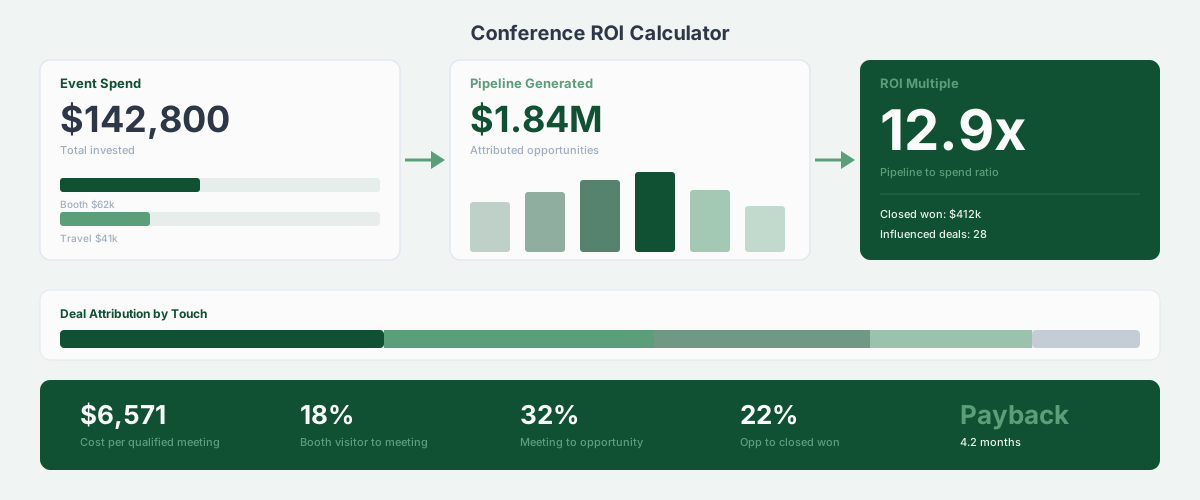
Ask any marketing leader how their last conference performed and you'll get one of two answers: "It was great, we got a lot of leads" or "Hard to tell." Neither is acceptable for a channel that costs $30,000-$100,000 per event. Conference ROI is measurable. It requires discipline, the right metrics, and a willingness to stop counting badge scans as a success metric.
Conference ROI measurement fails for three reasons.
Teams measure the wrong things. Badge scans, booth traffic, and social media impressions dominate post-event reports. None of these correlate reliably with revenue. A conference that generates 500 badge scans and zero qualified meetings performed worse than one that generated 50 scans and 20 meetings. But the first event looks better in a slide deck.
Attribution windows are too short. Most companies evaluate conference performance at 30 days. B2B sales cycles run 60-180 days. A conference in March that creates pipeline closing in August gets zero credit because nobody's looking anymore. The conference gets labeled "low ROI" and dropped from next year's budget.
No pre-event baseline. Without defining what success looks like before the event, every conference is evaluated on feelings. "The booth felt busy" isn't a metric. "We targeted 25 qualified meetings and booked 18" is a metric. The teams that measure well set targets before they set foot in the venue.
Forget badge scans. Forget impressions. Track these five numbers for every conference.
A qualified meeting is a conversation with a person who matches your ICP, has a relevant problem, and has agreed to a next step. This is the primary output metric for any conference. Track pre-booked meetings (set before the event) and on-site meetings (generated during the event) separately. Pre-booked meetings indicate how well your outreach worked. On-site meetings indicate how well your team worked the room.
Benchmark: A well-prepared team of four at a mid-size conference (SaaStr Annual, INBOUND, SaaStock) should book 15-25 qualified meetings across three days.
Pipeline created means new opportunities entered into your CRM that originated from a conference interaction. The 90-day window matters because conference follow-up takes time. A meeting at INBOUND in September might not become a formal opportunity until November after a demo and a stakeholder meeting.
Benchmark: Convert 30-50% of qualified meetings into pipeline opportunities. If you booked 20 meetings, expect 6-10 new opportunities.
This captures deals that already existed in your pipeline but were accelerated or advanced by a conference interaction. If your sales team met with an existing prospect at Dreamforce and the deal moved from evaluation to negotiation, that's pipeline influenced. This metric is often larger than pipeline created and is the number that justifies sponsorship renewals.
Tag every existing deal where a conference interaction occurred. Measure whether those deals progressed faster than deals without conference touchpoints. Over time, this builds a compelling dataset about the acceleration effect of in-person meetings.
Total event cost divided by total qualified meetings booked. This is your efficiency metric and the number that makes conference spending comparable to other channels.
Total event cost includes: sponsorship fee, booth, travel, accommodation, meals, swag, hospitality events, and staff time (value each person's time at their daily rate). See our sponsorship cost breakdown for typical all-in numbers.
Benchmark: $1,500-$3,000 per qualified meeting is solid for mid-market B2B. Under $1,500 is excellent. Over $4,000 means the event is either too expensive for your deal size or your team isn't preparing well enough.
The ultimate metric. How much revenue did the conference generate? Measure this at 6 months and again at 12 months. Some deals take that long to close, and cutting the measurement window short undercounts conference value.
Calculate the ratio: closed revenue divided by total event cost. A 3:1 ratio is healthy. A 5:1 ratio means the event should be a permanent fixture on your calendar. Below 2:1, question whether the event is worth continuing.
Measurement starts before the conference, not after. Here's how to set targets.
Work backward from revenue. If you need the conference to generate $200,000 in pipeline and your average deal size is $40,000, you need 5 opportunities. If your meeting-to-opportunity conversion rate is 40%, you need 13 qualified meetings. If you need 13 meetings, your team needs to run pre-event outreach to at least 60-80 people (assuming a 15-20% meeting acceptance rate).
Set tiered targets. Minimum viable: 10 meetings. Target: 18 meetings. Stretch: 25 meetings. This gives your team something to aim for and a clear standard for evaluation.
Define "qualified" before the event. Write down exactly what counts as a qualified meeting. Title must be Director+. Company must match your ICP criteria. Prospect must have expressed interest in a specific problem your product solves. Without this definition, your team will count every booth conversation as a meeting, and your data will be useless.
Conference ROI unfolds over months, not days. Here's when to measure what.
Day of event: Log every qualified conversation in real time. Name, company, title, what they care about, agreed next step. Do this in a shared doc or Slack channel during the event. Waiting until you're home means losing half the context.
Week 1 post-event: All conversations logged in CRM. Follow-up emails sent. First meetings booked. Report: total meetings, total badge scans, conversion rate from scan to meeting.
30 days post-event: Count pipeline created. How many new opportunities exist that originated from the conference? Report: pipeline value created, cost per meeting.
90 days post-event: Pipeline update. How many opportunities are progressing? How many went cold? Add pipeline influenced (existing deals that accelerated due to conference interactions). Report: total pipeline (created + influenced), opportunity progression rate.
6 months post-event: Closed revenue report. How much of the conference pipeline has closed? Calculate total ROI. Report: revenue generated, ROI ratio, cost per closed deal.
12 months post-event: Final revenue reconciliation for long-cycle deals. This is the number that goes into next year's conference planning.
Multi-touch attribution makes conference measurement complicated but not impossible. Here are two models that work in practice.
Source attribution. The conference gets credit as the "source" if the first meaningful touchpoint was at the event. The prospect had no prior engagement with your company before the conference interaction. This is the cleanest attribution model and the easiest to defend internally.
Influence attribution. The conference gets credit as an "influencer" if the prospect was already in your pipeline but had a meaningful interaction at the event. The deal existed before the conference, but the in-person conversation moved it forward. Track this by tagging CRM records with a "Conference Touch" field.
Run both models simultaneously. Source attribution shows how well the conference generates new pipeline. Influence attribution shows how well it accelerates existing deals. Together, they capture the full value of in-person events.
Once you've measured two or more conferences with the same framework, you can compare them. This is where the compounding value of disciplined measurement shows up.
Create a comparison table:
After two years, you'll have data on 8-12 events. Patterns emerge. Maybe SaaStr Annual consistently delivers $2,000 cost-per-meeting while INBOUND runs $3,500. Maybe smaller events like MozCon or Spryng deliver fewer meetings but at a higher conversion rate. Maybe vendor events like 6sense Breakthrough generate more pipeline influenced because the attendees are already in-market.
This dataset becomes your most valuable conference planning asset. Use it alongside speaker data and sponsor intelligence to make conference selection a data-driven decision.
Within one week of every conference, run a 30-minute debrief with everyone who attended. Cover these questions:
Document the answers and store them with your measurement data. Next year, when you're deciding whether to sponsor the same event, you'll have both quantitative performance data and qualitative team feedback.
The companies that measure conference ROI systematically build an information advantage. After three years of disciplined measurement, their conference portfolio is optimized in ways that companies relying on gut feel can't match. The framework isn't complicated. It just requires commitment to tracking a few numbers consistently, across every event, over time.
Start by reading our conference marketing strategy guide for the full playbook on pre-event, on-site, and post-event execution. Better execution feeds directly into better ROI numbers.
A preview of what's in the database.
| Name | Title | Company | Level | Conference(s) | |
|---|---|---|---|---|---|
| Dario Amodei | Co-Founder & CEO | Anthropic | C-Level | INBOUND,Dreamforce | LinkedIn ↗ |
| Mati Staniszewski | Co-Founder & CEO | ElevenLabs | C-Level | INBOUND,Dreamforce | LinkedIn ↗ |
| Yamini Rangan | CEO | HubSpot | C-Level | INBOUND,SaaStr Annual | LinkedIn ↗ |
| Kerry Cunningham | Head of Research & Thought Leadership | 6sense | Head of | INBOUND,6sense Breakthrough | LinkedIn ↗ |
| Olivier Godement | Head of Platform | OpenAI | Head of | INBOUND,Dreamforce | LinkedIn ↗ |
| Aaron Levie | CEO | Box | C-Level | SaaStr Annual | LinkedIn ↗ |
Showing 6 of 887 speakers. Get full access to filter and export.
Full speaker and sponsor data available for these conferences.
887 speakers, 487 sponsors, 13 conferences. Filter, search, and export.