Conference sponsorship pricing is one of the least transparent line items in B2B marketing. Most events don't publish their rates publicly. You have to request a prospectus, sit through a sales call, and sometimes sign an NDA before you see a number. That opacity makes it hard to benchmark, hard to budget, and hard to know if you're getting a fair deal. This guide breaks down what companies actually pay across the major B2B conferences.
The sponsorship fee on the invoice is never the full cost. It's the sticker price. The actual cost of sponsoring a B2B conference includes the fee plus travel, booth construction, staffing, swag, shipping, hospitality events, and opportunity cost of pulling your team off their normal work for a week.
Here's the breakdown most teams discover too late:
Sponsorship fee: 40-50% of total cost. This is what you pay the event organizer for your tier, booth space, branding, and included benefits.
Booth and setup: 15-25% of total cost. Custom booth builds run $5,000-$15,000 for a 10x10 space. Pop-up banners and a table are $500-$2,000. Drayage (the fee the venue charges to move your materials from the loading dock to the booth) can add $1,000-$5,000 depending on the venue.
Travel and accommodation: 15-20% of total cost. A team of four attending a three-day conference in San Francisco or Boston will spend $6,000-$12,000 on flights, hotels, and meals. Send six people and you're looking at $10,000-$18,000.
Swag and materials: 5-10% of total cost. T-shirts, stickers, printed one-pagers, demo devices. This adds up fast if you're producing anything custom.
Hospitality and entertainment: 5-15% of total cost. Client dinners, happy hours, VIP events. These often generate the best conversations, but they're expensive to produce.
Pricing varies significantly based on the conference's size, audience, and brand. Here's what the market looks like across the events KeynoteData tracks.
Dreamforce is the most expensive B2B conference to sponsor. Salesforce runs a tight ship on monetization. Basic expo booths start around $15,000-$25,000. Mid-tier "Silver" sponsorships that include session branding and dedicated meeting rooms run $50,000-$100,000. Top-tier packages with keynote stage visibility, custom event spaces, and full attendee access can exceed $250,000. The event draws 40,000+ attendees, so the cost-per-impression math can work, but only if your team can actually work the volume. See our Dreamforce conference profile for speaker and sponsor data.
SaaStr Annual is the flagship event for SaaS operators. Sponsorship starts around $10,000-$15,000 for a startup expo booth. Standard packages with better placement and branding run $25,000-$50,000. Premium sponsorships with speaking slots and dedicated lounges range from $50,000-$150,000. The audience skews heavily toward SaaS founders, CROs, and VPs, which makes it one of the most targeted events in B2B. That seniority concentration justifies the price for companies selling to SaaS leadership. Check our SaaStr Annual profile for details.
HubSpot's INBOUND conference offers sponsorships starting around $8,000-$12,000 for a basic expo presence. The next tier with session sponsorship and attendee list access runs $25,000-$50,000. Diamond-level packages with main stage branding and premium booth locations can hit $75,000-$150,000. INBOUND has a broader audience than SaaStr, spanning SMB through enterprise marketing and sales teams. It's good for wide-funnel awareness but less targeted for niche plays. See our INBOUND conference page.
SaaStock offers strong value for companies targeting the European SaaS market. Booth packages start around $5,000-$10,000. Mid-tier sponsorships run $15,000-$30,000. The event is smaller (3,000-5,000 attendees), which means higher meeting density and less noise. If you're expanding into EMEA, SaaStock is one of the most efficient sponsorship investments. Details on our SaaStock page.
MozCon is a focused SEO and content marketing event with 1,500-2,000 attendees. Sponsorships start around $5,000-$8,000. It's one of the more affordable options, and the audience is highly engaged and specific. If your product serves SEO teams, content marketers, or marketing agencies, the conversion rates from MozCon sponsorship tend to be higher per dollar than larger, more diffuse events. Our MozCon profile has the full breakdown.
LeadsCon targets lead generation and performance marketing professionals. Booth sponsorships start around $6,000-$12,000. Premium packages run $20,000-$40,000. The audience is heavily oriented toward demand gen, affiliate marketing, and lead buying, which makes it a strong fit for companies selling to growth and performance marketing teams. See our LeadsCon profile.
Vendor-hosted conferences like 6sense Breakthrough are a different animal. Sponsorship is typically by invitation or partnership, with costs ranging from $10,000-$50,000 depending on the relationship. The audience is pre-qualified (existing 6sense customers and their networks), which means you're reaching companies already invested in intent data and ABM. Check the 6sense Breakthrough profile for speaker data.
Sales-focused conferences like OutBound Conference and Sales 3.0 are smaller, more tactical events. Sponsorships typically run $5,000-$20,000. The audience is sales leaders and practitioners. If you sell sales enablement, outreach tools, or coaching services, these events deliver high-intent conversations at a fraction of what Dreamforce costs.
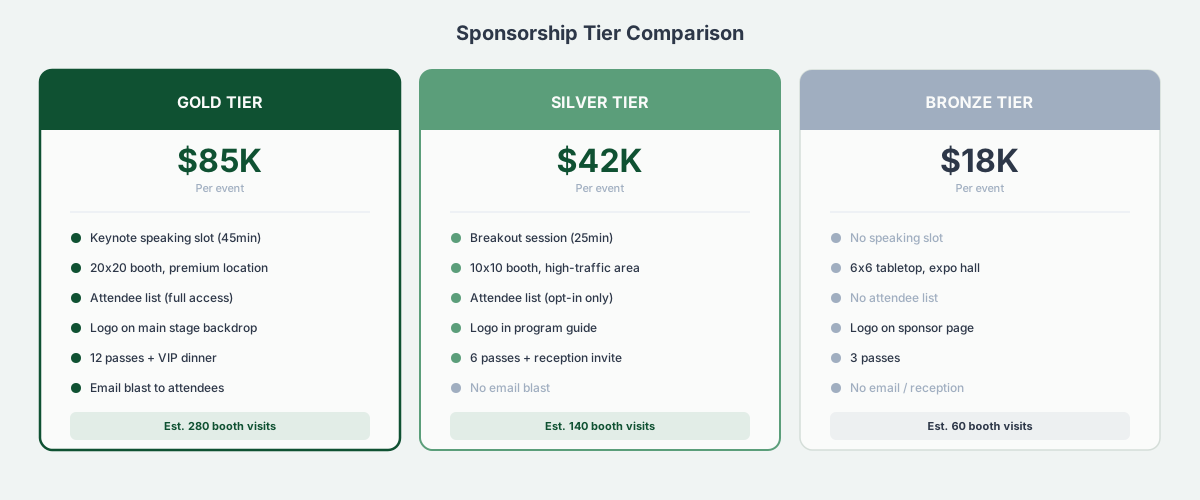
Conference sponsorship typically comes in 3-5 tiers. Here's what each tier actually includes and whether the upgrade is worth it.
Expo booth (lowest tier). You get a booth space, your logo on the sponsor page, and basic badge scanning. This is the "you're in the room" tier. Good for brand awareness and if your team is disciplined about outbound meeting booking. Usually $5,000-$25,000 depending on the event.
Silver/Gold (mid-tier). Everything in the expo tier plus session branding, a speaking slot (sometimes), better booth placement, and usually access to the attendee list. The attendee list is the most valuable inclusion at this tier. It lets you run pre-event outreach to the entire audience. Usually $20,000-$75,000.
Platinum/Diamond (top tier). Main stage branding, a dedicated lounge or meeting space, premium booth location, guaranteed speaking slot, full attendee data, and logo placement on all event communications. This tier only makes sense if your brand is in a category-defining moment or if you're running a high-volume enterprise sales motion where visibility directly converts to meetings. Usually $50,000-$250,000+.
The jump from expo to mid-tier is almost always worth it because of the attendee list. The jump from mid-tier to top-tier is worth it only if you have the team size to capitalize on the extra visibility.
Even experienced event marketers get caught by these.
Drayage. Convention centers charge per hundred pounds to move your booth materials from the loading dock to your space. This can cost $1,000-$5,000, and some venues charge penalties for late arrivals.
Electricity and internet. Many venues charge separately for booth electricity ($300-$800) and wired internet ($500-$1,500). Wifi is often unreliable on the expo floor due to the number of devices.
Lead scanning add-ons. Some conferences include badge scanners in the sponsorship package. Others charge $500-$1,500 per device, or require you to use their paid lead retrieval platform.
Furniture rental. Your booth space might be just a patch of carpet. Tables, chairs, monitors, and counters are often rented separately from the venue, adding $500-$3,000.
After-event fees. Some conferences charge for post-event attendee data access or limit how many leads you can export from their scanning platform. Read the contract carefully.
The metric that matters is cost per qualified meeting. Here's the formula:
Total event cost (sponsorship + travel + booth + swag + hospitality + hidden fees) divided by number of qualified meetings booked.
For a mid-market SaaS company sponsoring INBOUND at $30,000 with $25,000 in additional costs, the total is $55,000. If the team books 22 qualified meetings, the cost per meeting is $2,500. If your average deal size is $40,000 and you close 15% of qualified meetings, that's $132,000 in expected revenue against $55,000 in cost. A 2.4:1 return before accounting for pipeline influenced.
If the same team attends SaaStock for $35,000 total and books 18 meetings, the cost per meeting is $1,944. Smaller conferences often deliver better cost-per-meeting because there's less competition for attention. Read our full sponsorship ROI framework for more on this math.
Commit early. Most conferences offer 15-25% early-bird discounts for commitments made 6+ months before the event. This is the single biggest lever you have.
Bundle events. If the organizer runs multiple conferences, ask for a multi-event discount. A 3-event package often comes at 20-30% less than buying each individually.
Ask about cancellation inventory. Four to six weeks before the event, some sponsors drop out. The conference needs to fill the space. You can sometimes get a mid-tier package at expo pricing if you move fast.
Negotiate inclusions, not just price. Adding a speaking slot, an attendee list, or a hosted meeting room to your package can be worth more than a $5,000 discount. Conference sales reps have more flexibility on inclusions than on price.
Use competitive intel. If you know your competitor sponsors the same event, mention it. Conference organizers want both sides of a competitive pair in the room because it signals a hot category. Use KeynoteData's sponsor intelligence to research who's already committed.
Sponsorship isn't always the right play. Here are the signals to attend without sponsoring:
Your ACV is below $15,000 and the sponsorship costs more than $10,000. The math rarely works at that deal size unless your close rate from conference meetings is unusually high.
You've never attended the event before. It's risky to sponsor a conference you haven't scouted. Attend first, validate that your ICP is actually there, and then sponsor the following year.
The speaker roster doesn't match your target accounts. If you cross-reference the speaker database against your target list and find zero overlap, the audience likely isn't right. Don't pay premium prices for the wrong room.
You don't have the team to work it. Sponsoring a conference with two people is almost always a waste. You need enough people to staff the booth, attend sessions, work the hallways, and run pre-booked meetings simultaneously. If you can't send at least four people, attend without sponsoring and focus on outbound meeting booking.
Start with your annual conference marketing budget, then work backward from cost per meeting targets.
A common allocation for mid-market B2B SaaS companies:
If your total conference marketing budget is $150,000, that's $75,000-$90,000 for sponsored events, $30,000-$37,500 for attended events, $15,000-$22,500 for outreach, and $15,000 for buffer. That's enough to sponsor two mid-tier events like SaaStr Annual and SaaStock, attend two more like LeadsCon and INBOUND, and still have room for pre-event campaigns and post-event follow-up. For more on how to allocate across channels, see our conference budget allocation guide.
The companies that get the best return on conference sponsorship aren't the ones that spend the most. They're the ones that spend deliberately, on events where their ICP is verified, with teams that are prepared before they arrive. The sponsorship fee gets you in the door. Everything you do before and after determines whether it was worth it.
A preview of what's in the database.
| Name | Title | Company | Level | Conference(s) | |
|---|---|---|---|---|---|
| Dario Amodei | Co-Founder & CEO | Anthropic | C-Level | INBOUND,Dreamforce | LinkedIn ↗ |
| Mati Staniszewski | Co-Founder & CEO | ElevenLabs | C-Level | INBOUND,Dreamforce | LinkedIn ↗ |
| Yamini Rangan | CEO | HubSpot | C-Level | INBOUND,SaaStr Annual | LinkedIn ↗ |
| Kerry Cunningham | Head of Research & Thought Leadership | 6sense | Head of | INBOUND,6sense Breakthrough | LinkedIn ↗ |
| Olivier Godement | Head of Platform | OpenAI | Head of | INBOUND,Dreamforce | LinkedIn ↗ |
| Aaron Levie | CEO | Box | C-Level | SaaStr Annual | LinkedIn ↗ |
Showing 6 of 887 speakers. Get full access to filter and export.
Full speaker and sponsor data available for these conferences.
887 speakers, 487 sponsors, 13 conferences. Filter, search, and export.