Conference budgets have a way of growing unchecked. You start with a $15,000 sponsorship and end up spending $55,000 once you add travel, booth setup, swag, and a dinner event. Then multiply that by four conferences and suddenly 30% of your marketing budget is going to events without a clear allocation framework. This guide breaks down how to plan and distribute your conference marketing budget so every dollar has a job.
Most teams build their conference budget bottom-up: they pick events first, add up the costs, and present the total for approval. This approach inflates budgets because every event seems worth attending in isolation.
Work top-down instead. Start with your total marketing budget. Decide what percentage goes to conferences. Then allocate within that constraint.
For B2B companies where events are a proven pipeline channel, conference spending typically runs 20-30% of the total marketing budget. For a company with a $500,000 marketing budget, that's $100,000-$150,000 for all conference-related spending. For a company with a $200,000 budget, it's $40,000-$60,000.
If you haven't proven that conferences work for your company yet, start lower. Allocate 10-15% of budget to test 2-3 events, measure the results, and scale if the numbers justify it.
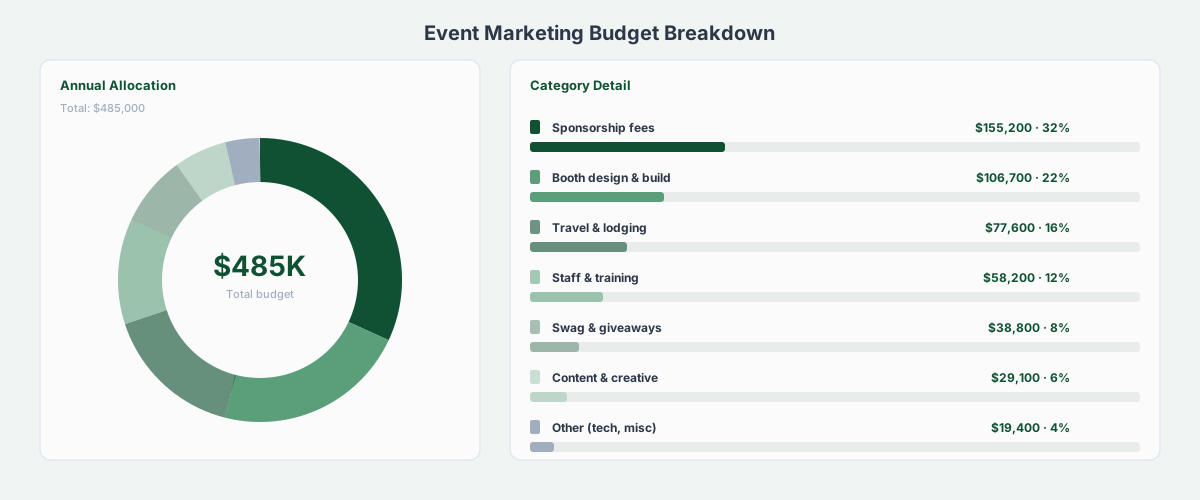
Once you have your total conference budget, split it across five categories.
This is the check you write to the event organizer. It covers your sponsorship tier, booth space, any included benefits (attendee lists, speaking slots, branding), and registration fees.
At a $100,000 total conference budget, this means $35,000-$45,000 for sponsorship fees across all events. That's enough for one mid-tier sponsorship at a major event like SaaStr Annual ($25,000-$40,000) plus a smaller sponsorship at a focused event like SaaStock ($8,000-$15,000).
For specific pricing by event, see our conference sponsorship cost guide.
Flights, hotels, ground transportation, meals, and per diems for your team. This category scales linearly with team size and conference location.
Budget $2,000-$3,500 per person per conference for domestic events (US). International events run $3,500-$6,000 per person. A team of four at two domestic conferences: $16,000-$28,000.
This is the category most teams underestimate. Always budget for one more night than the conference length (teams arrive the day before and often have meetings the day after).
Booth design and construction, signage, monitors, furniture rental, drayage, electricity, internet, and any production costs for demos or displays.
A professional pop-up booth costs $2,000-$5,000. A custom-built booth for a 10x10 space runs $5,000-$15,000. Add $2,000-$5,000 for venue-specific costs (drayage, power, internet).
Reusable booth components amortize over multiple events. Invest in a quality, modular setup your first year and it pays for itself by the third conference.
This is the most under-allocated category and the one with the highest ROI impact. Pre-event campaigns include LinkedIn ads targeting confirmed attendees, direct outreach email sequences, personalized direct mail to target accounts, and content creation for pre-event nurture.
Post-event campaigns include follow-up email sequences, retargeting ads, and content offers sent to leads collected at the event.
Teams that allocate 10-15% of their conference budget to campaigns around the event book 2-3x more meetings than teams that rely solely on the booth and walk-up traffic. A $10,000-$15,000 investment in pre-event outreach for a $40,000 conference sponsorship can double your meeting count. Read our conference marketing strategy guide for the full pre-event playbook.
Client dinners, happy hours, VIP breakfasts, and private events. These are optional but powerful for enterprise sales motions and strategic relationship building.
A dinner for 8-12 target accounts costs $2,000-$5,000 depending on the city. A happy hour for 20-30 people runs $3,000-$8,000. A private meeting room at the conference for 1:1s costs $500-$2,000 per day.
If your deal size is above $50,000, hospitality events almost always pay for themselves through accelerated deals. If your deal size is below $20,000, skip the dinners and redirect the budget to pre-event outreach.
Here's how the allocation plays out at different budget levels.
With $50,000, you can sponsor one focused event and attend 2-3 others without sponsoring.
At this level, event selection is critical. You can't afford to sponsor the wrong conference. Use speaker data to verify ICP overlap before committing. See our guide on how to choose which conferences to attend for the full selection framework.
At $150,000, you can sponsor two anchor events and attend three to four more.
This budget supports a real conference program. The key is choosing anchor events wisely and investing heavily in pre-event campaigns. The $20,000 in campaign spend should drive 40-60% of your total conference meetings.
At this level, conferences are a core pipeline channel alongside outbound and paid advertising.
With a $300,000 budget, you should be tracking conference ROI rigorously across every event. At this spend level, even a 10% improvement in event selection or execution represents $30,000 in recovered efficiency.
The single most impactful change most teams can make to their conference budget is shifting dollars from booth and swag into pre-event outreach.
A typical reallocation: cut booth spend from $10,000 to $5,000 (use a clean, modular setup instead of a custom build). Cut swag from $3,000 to $1,000 (nobody needs another branded water bottle). Take that $7,000 and put it into pre-event LinkedIn ads and direct outreach.
The math works because pre-event outreach converts at much higher rates than walk-up booth traffic. A pre-booked meeting is 3-5x more likely to convert to pipeline than a chance booth conversation. Every dollar moved from "hope they stop by" to "we have a meeting scheduled" improves your cost per qualified meeting.
Conferences cluster seasonally. Most B2B events run in Q1 (January-March) and Q3 (September-November). Q2 and Q4 are lighter.
This creates a cash flow problem if you budget annually but spend in bursts. A $150,000 annual budget might require $80,000 in Q3 alone if your two anchor events both fall in September-October (SaaStr Annual in September, INBOUND in September).
Solution: map your conference calendar to quarterly spend projections at the start of the year. Flag months where spend will spike. This prevents the awkward conversation where finance asks why marketing spent 60% of its quarterly budget in six weeks.
Always hold 10% of your conference budget as buffer. Conference costs are unpredictable. Drayage fees surprise you. A last-minute opportunity to sponsor a side event opens up. A team member gets sick and you need to fly in a replacement.
Without a buffer, you either miss opportunities or blow your budget. Neither is a good outcome. Build the buffer into your plan from the start and spend it only when the ROI case is clear.
After each conference, compare your actual spend to your planned allocation. Where did you overspend? Where did you underspend? Did the budget distribution correlate with results?
Over time, you'll find your optimal allocation ratios. Maybe pre-event campaigns deserve 20% instead of 12%. Maybe hospitality generates more pipeline than you expected. Maybe your booth spend is higher than necessary. Use the data from each event to refine next year's framework.
Track cost per qualified meeting for each event and compare it against other pipeline generation channels. If conferences deliver meetings at $2,000 each and outbound SDR delivers them at $1,200, but conference meetings convert at 40% versus outbound's 20%, the conference is actually cheaper per opportunity ($5,000 vs $6,000). Present this full-funnel analysis to leadership to justify and optimize your conference budget. See our ROI measurement framework for the complete methodology.
The best conference budgets aren't the biggest ones. They're the ones where every line item has a clear purpose, every event has a clear target, and every dollar spent gets measured against results. Start with the total number, allocate by category, invest disproportionately in pre-event outreach, and hold a buffer for reality. Then measure, learn, and improve the allocation every cycle.
A preview of what's in the database.
| Name | Title | Company | Level | Conference(s) | |
|---|---|---|---|---|---|
| Dario Amodei | Co-Founder & CEO | Anthropic | C-Level | INBOUND,Dreamforce | LinkedIn ↗ |
| Mati Staniszewski | Co-Founder & CEO | ElevenLabs | C-Level | INBOUND,Dreamforce | LinkedIn ↗ |
| Yamini Rangan | CEO | HubSpot | C-Level | INBOUND,SaaStr Annual | LinkedIn ↗ |
| Kerry Cunningham | Head of Research & Thought Leadership | 6sense | Head of | INBOUND,6sense Breakthrough | LinkedIn ↗ |
| Olivier Godement | Head of Platform | OpenAI | Head of | INBOUND,Dreamforce | LinkedIn ↗ |
| Aaron Levie | CEO | Box | C-Level | SaaStr Annual | LinkedIn ↗ |
Showing 6 of 887 speakers. Get full access to filter and export.
Full speaker and sponsor data available for these conferences.
887 speakers, 487 sponsors, 13 conferences. Filter, search, and export.