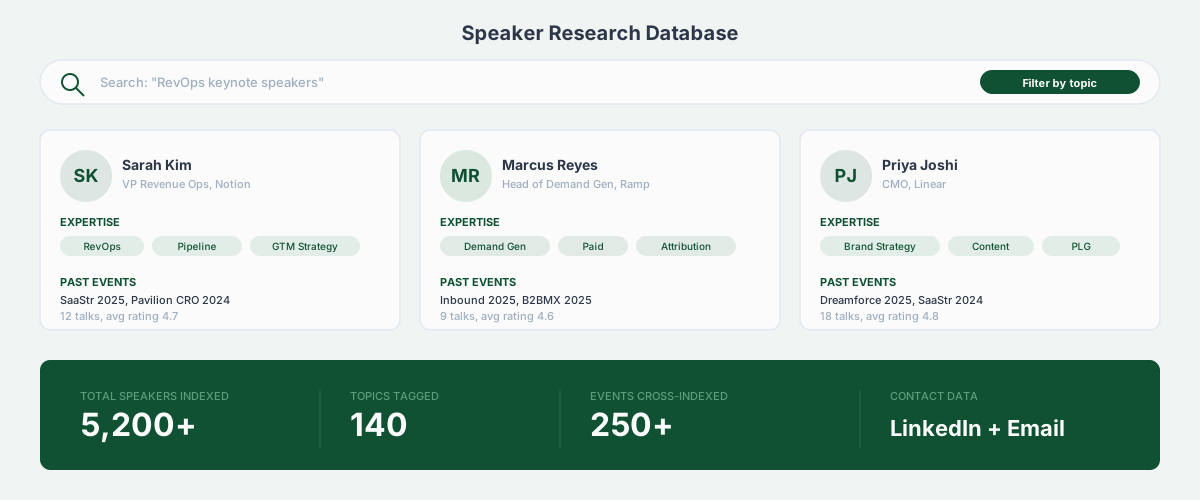
Every B2B conference publishes a speaker list. It sits on the event website, usually in a grid of headshots and titles. Most marketers skim it to see if anyone famous is presenting, then move on. That's a missed opportunity. Speaker rosters are one of the richest public data sources in B2B, and almost nobody treats them that way.
A conference speaker list maps who's shaping the conversation in your market, which companies are investing in visibility, and what topics buyers care about right now.
Here's what you can extract from a single speaker roster:
Audience seniority. Speaker seniority strongly correlates with audience seniority. A conference that features mostly C-suite and VP speakers attracts senior buyers. An event with mostly Director and Manager speakers attracts a more tactical, mid-level audience. This matters if you sell to a specific level. If your product requires VP-level sign-off, a conference full of Manager-level speakers won't generate pipeline.
Company representation. Every speaker represents a company. That company likely has 5-20 other people at the event. If you're running account-based marketing, the speaker list is your best proxy for the attendee list (which conferences rarely share publicly). Look for your target accounts in the speaker roster. If three of your top 50 accounts have speakers at the event, their teams are in the building.
Topic trends. Session titles and speaker bios tell you what the conference thinks its audience cares about. If there are four sessions on AI-powered sales tools and zero on cold email, the audience has moved on from one topic to the other. These shifts happen faster at conferences than in published content because program committees are selecting for current relevance.
Competitive presence. Are your competitors' executives speaking? If your competitor's CMO is keynoting at INBOUND, they're getting massive visibility with your shared audience. That's worth knowing. It should influence your own event strategy and potentially your content calendar.
A single speaker list is useful. Comparing speaker lists across conferences is where it gets powerful.
Some speakers appear at one event. They were invited for a specific topic or they had a relationship with the organizers. Fine. But some speakers appear at 3, 5, even 8 conferences in a single year. These are the circuit regulars, and they deserve attention.
Circuit regulars are industry influencers. They've been vetted by multiple program committees. Their perspectives shape how thousands of professionals think about a category. If you're doing thought leadership marketing, these are the people you want to know (and the people your executives should be on stage alongside).
Multi-event speakers reveal conference clustering. When the same people speak at INBOUND, SaaStr Annual, and 6sense Breakthrough, it tells you those events draw from the same professional community. If you can only attend two of those three, the speaker overlap data helps you choose.
Companies with speakers at many events are signaling something. A company that places speakers at 5+ conferences per year has a deliberate speaker placement strategy. They're building brand, generating awareness, and creating demand. Track which companies do this and you'll see who's investing most aggressively in thought leadership as a growth channel.
This is the most practical application and the one that saves the most money.
Conference tickets and sponsorships are expensive. A wrong bet costs $15,000-$80,000 when you add up all the line items. Speaker research helps you make better bets.
Here's the method:
Step 1: Define your target profile. What seniority level do you need in the room? What functions (marketing, sales, RevOps, product)? What company size? Be specific.
Step 2: Pull speaker rosters. For every conference you're considering, get the full speaker list. KeynoteData's speaker database has this for 13 B2B conferences with seniority tags, company data, and LinkedIn profiles. Or do it manually from conference websites, though that takes 30-60 minutes per event.
Step 3: Score each event. For each conference, count how many speakers match your target profile. How many are from your target accounts? What percentage are at the seniority level you need? Create a simple scorecard.
Step 4: Compare and decide. Rank your conference options by score. The event with the highest concentration of your ICP speakers is your best bet. This doesn't guarantee results, but it dramatically increases your odds compared to choosing based on brand name or inertia.
A B2B marketing team that used this approach told us they cut their conference budget from 6 events to 3, doubled down on the three best-fit conferences, and generated more pipeline than the previous year's 6-event spread.
This application is less obvious but equally valuable. Speakers at B2B conferences are, by definition, people with influence and budget at their companies. They're senior enough to be invited to speak, and they work at companies that support their speaking engagements.
For sales teams, a conference speaker list is a curated prospect list.
Speakers are reachable. Most speakers have their LinkedIn profiles on the conference website. Even if they don't, their name, title, and company are public. That's enough to find them.
Speakers are receptive. Someone who just gave a talk at SaaStr Annual is in growth mode. They're sharing ideas, building their profile, open to connections. A personalized outreach that references their talk converts at a higher rate than cold outbound to the same person.
Speakers represent buying committees. A Director of Demand Gen speaking at LeadsCon might not be your direct buyer, but they influence the budget. And their VP (who's probably in the audience) might be. Speaker data gives you a way into the account.
The approach: identify speakers at your target accounts. Connect on LinkedIn before the event. Reference their upcoming talk. Attend their session. Follow up with a relevant insight. This sequence converts because it's built on genuine engagement, not a sales script.
Your competitors' speaking activity tells you about their go-to-market strategy.
Topic selection reveals positioning. If your competitor's VP of Product is speaking at three conferences about "AI-native analytics," that's their positioning bet. They're investing speaking slots to own that narrative. You now know what message they're pushing to your shared audience.
Conference selection reveals market focus. A competitor that speaks at INBOUND, SaaStr, and SaaStock is targeting the broad B2B SaaS market. A competitor that speaks at MozCon, BrightonSEO, and Content Marketing World is focused on the SEO/content vertical. Their conference choices map to their ICP.
Speaker seniority reveals investment level. If a competitor sends their CEO to speak, they're investing heavily in thought leadership at that event. If they send a product marketer, it's a lighter touch. The seniority of the speaker signals how important the company considers that audience.
Build a competitive speaking tracker. Log which competitors speak where, what topics they cover, and how their presence changes over time. After two quarters, you'll have a clear picture of their event strategy that would be hard to get any other way.
Speaker research sounds straightforward. In practice, it's tedious.
Conference websites display speakers in grids with photos, names, and titles. Some include companies. Fewer include LinkedIn profiles. Almost none let you filter by seniority or search across events. To do proper cross-conference speaker analysis, you need to:
For 5 conferences, this takes a full day. For 13, it takes multiple days. And the data goes stale fast because conferences add and remove speakers throughout their planning cycle.
This is the problem KeynoteData solves. We track 887 speakers across 13 B2B conferences with standardized seniority tags, company data, and LinkedIn profiles. You can filter by conference, company, seniority level, or function. Cross-conference analysis that would take days is available in seconds.
If you've never done structured speaker research, here are five concrete actions to start with:
1. Pull the speaker list for your next conference. If you're attending or sponsoring an event in the next 90 days, download the speaker list. Categorize by seniority. Cross-reference with your target account list. You'll walk in knowing exactly who to find.
2. Find the circuit regulars in your space. Identify 3-5 speakers who appear at multiple events in your category. Follow them on LinkedIn. Read their content. These are the people shaping the narrative in your market.
3. Map your competitors' speaking footprint. List every conference where your top competitors had speakers last year. Look for patterns. Are they concentrating on certain events? Expanding into new ones? This feeds directly into your conference marketing strategy.
4. Identify speaking gaps. Look at conferences where your company's profile fits but you haven't placed a speaker. Compare the speaker list to your executive team. If the event features speakers at your seniority level, from similar companies, talking about adjacent topics, your executive could be on that stage. See our guide on landing speaking opportunities.
5. Build a target account hit list. Pull speakers from your top 3 target accounts across all conferences they appear at. Connect on LinkedIn. Engage with their content. Use the conference as a reason to reach out. These are warm leads by the time you meet at the event.
The data is public. The analysis is straightforward. The value is clear. So why don't more teams do structured speaker research?
Two reasons. First, the manual effort is high enough that it falls off the priority list. There's always something more urgent than building a speaker cross-reference spreadsheet. Second, most marketers think of speaker lists as event logistics, not strategic data. They look at speakers to decide which sessions to attend, not to inform their go-to-market strategy.
That's what makes it a competitive edge. The bar is low. Most of your competitors aren't doing this. The few that are have a significant information advantage when it comes to event selection, pre-event outreach, and competitive positioning.
The question isn't whether speaker research is valuable. It's whether you're willing to do it before your competitors figure it out.
A preview of what's in the database.
| Name | Title | Company | Level | Conference(s) | |
|---|---|---|---|---|---|
| Dario Amodei | Co-Founder & CEO | Anthropic | C-Level | INBOUND,Dreamforce | LinkedIn ↗ |
| Mati Staniszewski | Co-Founder & CEO | ElevenLabs | C-Level | INBOUND,Dreamforce | LinkedIn ↗ |
| Yamini Rangan | CEO | HubSpot | C-Level | INBOUND,SaaStr Annual | LinkedIn ↗ |
| Kerry Cunningham | Head of Research & Thought Leadership | 6sense | Head of | INBOUND,6sense Breakthrough | LinkedIn ↗ |
| Olivier Godement | Head of Platform | OpenAI | Head of | INBOUND,Dreamforce | LinkedIn ↗ |
| Aaron Levie | CEO | Box | C-Level | SaaStr Annual | LinkedIn ↗ |
Showing 6 of 887 speakers. Get full access to filter and export.
Full speaker and sponsor data available for these conferences.
887 speakers, 487 sponsors, 13 conferences. Filter, search, and export.