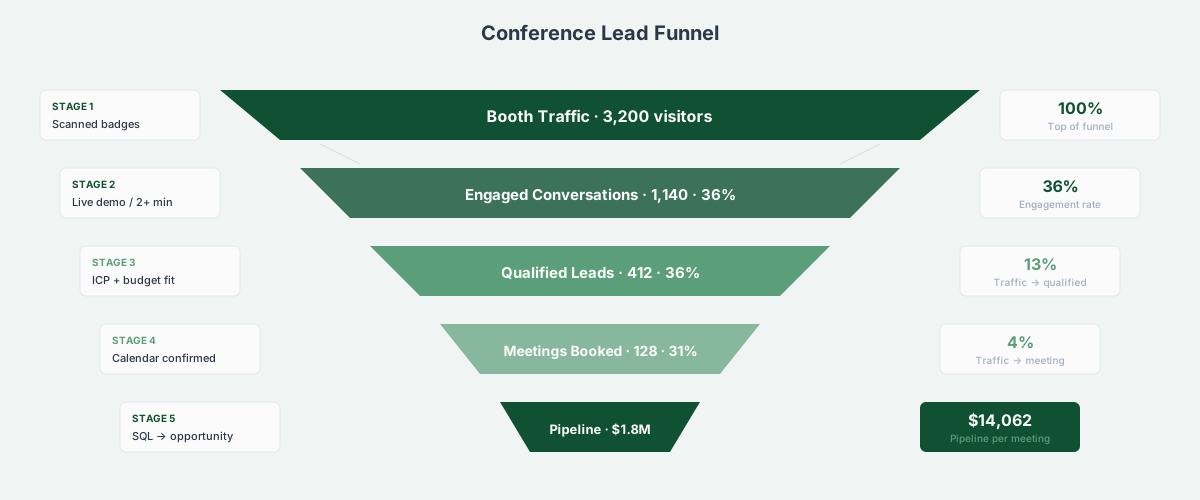
Most conference booths are designed to attract foot traffic. Bright colors, big logos, giveaways, and games. The result is a stream of people who stop for free t-shirts and leave without a conversation. The booths that generate pipeline are designed differently. They are built to start conversations, qualify visitors quickly, and convert the right people into meetings. Here is how to design a booth that works as a pipeline engine.
Walk any expo hall at INBOUND, Dreamforce, or SaaStr Annual and you will see the same pattern. Giant logos on backwalls. Taglines that say nothing ("Empowering the Future of Work"). A table stacked with brochures nobody reads. A fishbowl for business cards. Two people standing behind the table, arms crossed, waiting for someone to approach.
This design optimizes for brand presence, not pipeline. It assumes that if enough people see your logo, some of them will eventually buy. That might be true for Coca-Cola, but it is not how B2B sales works. You are not building awareness with 10,000 random people. You need 15-25 qualified conversations that turn into meetings.
The shift is simple: design the booth for meetings, not traffic. Every element, from the headline to the layout to the staffing plan, should be built around one question: does this help us have more qualified conversations?
An attendee walking past your booth gives it 2-3 seconds. In that window, your booth needs to communicate three things: what problem you solve, who you solve it for, and why they should stop.
Your company name does not do any of those things. Your logo does not either. The headline on your backwall is the single most important design element because it is the only thing people will read while walking past at conference speed.
Bad headlines:
Good headlines:
The best headlines are questions that your ICP cannot resist. If a VP of Sales sees "Why do 60% of booked meetings no-show?" on your backwall, they will stop. It touches a nerve they feel every day. That is the opening your team needs.
The standard booth layout puts a table across the front of the booth with staff behind it. This creates a physical barrier between your team and the attendees. It signals "we are in here, you are out there." It makes the booth feel like a retail counter.
The meeting-optimized layout removes the barrier. Here is what works:
No front table. Move the table to the side or back. Your team should be standing in the aisle or at the open front of the booth, able to step toward people and start conversations.
A demo station on the side. If you have a product demo, set up a monitor on a counter at the side of the booth. This lets you pull interested people in for a focused demo without blocking the main flow.
A semi-private meeting area. If your booth is 10x10 or larger, create a small meeting zone with two chairs or a standing table in the back corner. When you qualify someone as a strong fit, move them to this area for a focused 5-10 minute conversation. The slight separation from the expo floor noise signals "this is a real conversation" and increases the quality of the interaction.
Clear sightlines. Attendees should be able to see the headline and the people in the booth from 15+ feet away. Do not stack banners, plants, or display shelves that block the view. The booth should feel open and approachable from every angle.
Who you put in the booth matters more than what you put in the booth. A great booth with the wrong staff produces nothing.
Position 1: The greeter (front of booth). This person stands at the edge of the aisle and engages passersby. They need to be outgoing, quick-witted, and comfortable initiating conversations with strangers. Their job is to ask a qualifying question within the first 10 seconds. Not "Can I help you?" but "Are you dealing with [specific problem]?" or "Do you manage a [specific function] team?"
Position 2: The closer (inside the booth). This person takes over when the greeter qualifies someone. They run the demo, go deeper on the product, and set up the next step. This should be an AE or SE who can have a substantive technical or business conversation. The handoff from greeter to closer should be smooth: "You should talk to [Name], they work with teams exactly like yours."
Position 3: The meeting runner (rotating). For pre-booked meetings, you need someone dedicated to running those conversations. This person is not working walk-up traffic. They are taking 15-20 minute meetings with the targets you booked through pre-event outreach.
Rotate every 2-3 hours. Booth work is exhausting. Tired reps have worse conversations. A team of 4 people rotating in pairs gives everyone breaks while keeping the booth staffed at all times.
The single most powerful tool at your booth is a qualifying question that your team asks within 10 seconds of someone stopping. The question should:
Examples by persona:
If you sell to sales leaders: "How is your team handling [specific challenge]?" or "Are you seeing the same pipeline quality issues this quarter that everyone's talking about?"
If you sell to marketers: "How do you decide which conferences to sponsor?" or "What's your team doing about [specific trend]?"
If you sell to RevOps: "How long does it take your team to get a report on [metric]?"
The question opens the conversation. If the answer reveals they have the problem, your greeter transitions them to the closer. If they do not, your greeter thanks them and moves on. No time wasted on either side.
A booth demo is not a product walkthrough. It is a 3-5 minute highlight reel that shows one specific thing your product does that the person standing in front of you cares about.
Lead with the outcome, not the feature. "Let me show you how [Company X] cut their [metric] in half" is better than "Let me show you our dashboard."
Make it interactive. Ask the viewer a question during the demo. "What does your current process look like for this?" or "How many people on your team handle this today?" The more they talk, the more invested they become.
End with a specific next step. "This is a 3-minute version. If you want to see how it works with your data, I can set up a 30-minute session next week. Does Tuesday or Wednesday work?"
Have 2-3 demo scenarios prepared that map to different personas or use cases. If the qualifying question reveals they are a sales leader, run the sales demo. If they are in marketing, run the marketing demo. One-size-fits-all demos fail because they do not speak to the specific person.
Badge scanning is the standard at most conferences. The scanner captures name, title, company, and email. That data is useful for follow-up, but it is incomplete. A badge scan without context is just a name in a spreadsheet.
Add a notes system. After every meaningful conversation, the team member should record: what the person cares about, what they asked about, what stage they are at (evaluating, just learning, active pain), and the agreed next step. Most CRM mobile apps support quick note entry. If not, use a shared Google Doc or Slack channel.
Tier your leads immediately. Do not wait until after the conference to sort through 200 badge scans. Categorize in real time:
This tiering feeds directly into your post-conference follow-up sequence.
Skip expensive swag. Branded AirPods, high-end water bottles, and premium giveaways attract crowds of people who want free stuff. They do not attract buyers. If you must have swag, make it cheap and functional (stickers, pens). Invest the swag budget in a better demo setup or a networking dinner instead.
Skip the game or raffle. Prize wheels, plinko boards, and trivia games generate foot traffic and photos. They do not generate pipeline. Every minute your team spends running a game is a minute they are not having a real conversation with a qualified prospect.
Skip the brochure stack. Nobody reads brochures anymore. If someone wants information, they will visit your website. A QR code linking to a relevant case study or product page is more useful and costs nothing to produce.
Skip the company video on loop. A monitor playing a corporate video on loop is white noise at a conference. Use the monitor for live demos or to display a rotating set of customer quotes and data points that support conversations.
Track these metrics during the event:
After the event, track pipeline generated within 90 days. That is the real metric. Not badge scans, not "impressions," not social media mentions. Pipeline. For a full measurement framework, see our conference ROI measurement guide.
The booths that generate pipeline are not the biggest or the most expensive. They are the ones with a clear message, an open layout, a strong qualifying question, and a team that knows how to turn a 2-minute conversation into a booked meeting. Everything else is decoration.
A preview of what's in the database.
| Name | Title | Company | Level | Conference(s) | |
|---|---|---|---|---|---|
| Dario Amodei | Co-Founder & CEO | Anthropic | C-Level | INBOUND,Dreamforce | LinkedIn ↗ |
| Yamini Rangan | CEO | HubSpot | C-Level | INBOUND,SaaStr Annual | LinkedIn ↗ |
| Kerry Cunningham | Head of Research & Thought Leadership | 6sense | Head of | INBOUND,6sense Breakthrough | LinkedIn ↗ |
| Olivier Godement | Head of Platform | OpenAI | Head of | INBOUND,Dreamforce | LinkedIn ↗ |
| Aaron Levie | CEO | Box | C-Level | SaaStr Annual | LinkedIn ↗ |
| Mati Staniszewski | Co-Founder & CEO | ElevenLabs | C-Level | INBOUND,Dreamforce | LinkedIn ↗ |
Showing 6 of 887 speakers. Get full access to filter and export.
Full speaker and sponsor data available for these conferences.
887 speakers, 487 sponsors, 13 conferences. Filter, search, and export.