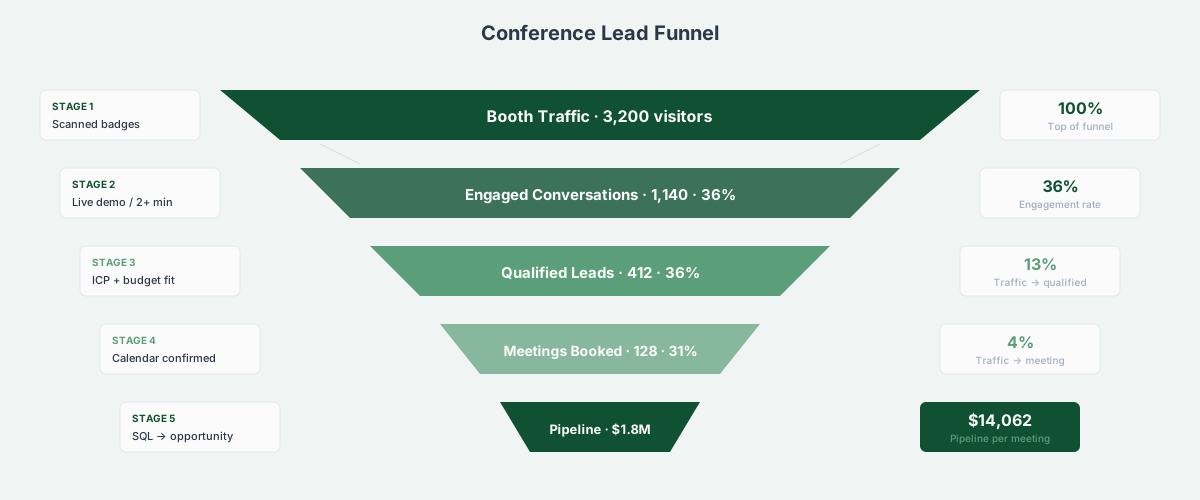
You spent $50,000 on a conference. You had 40 conversations, booked 15 meetings, and collected 200 badge scans. Now what? This is where most teams fail. They fly home, dump the badge scans into Salesforce, and send a generic email to the entire list a week later. By then, the conversations are forgotten, the momentum is gone, and the pipeline evaporates. The teams that convert conference leads into revenue follow a structured 48-hour playbook.
Conference leads have a half-life of about 72 hours. After three days, the person you met has returned to their inbox, their routine, and their existing priorities. Your conversation at the booth fades from "that was a good meeting" to "who was that company again?" to nothing.
The fix is simple: start follow-up before you leave the conference city. The best teams send their first round of follow-up emails on the last day of the event or the morning after. Not a week later. Not when they "get around to it." Within 48 hours.
This requires preparation. You cannot write 40 personalized follow-up emails from scratch the day after a conference. You need templates, a tiering system, and notes from each conversation ready to go. Here is the system.
Do not wait until after the conference to sort your leads. Tier them in real time, at the booth, as the conversations happen. Every team member should categorize each interaction immediately after it ends.
Tier 1: Hot. You had a substantive conversation. They have the problem you solve. They agreed to a specific next step (a demo, a call, joining your dinner, receiving a proposal). You know their name, company, role, and what they care about. These leads get personal follow-up within 24 hours.
Tier 2: Warm. Good conversation, genuine interest, but no commitment to a next step. Maybe they said "send me some info" or "let's connect after the event." You have their contact info and some context about their needs. These leads get semi-personalized follow-up within 48 hours.
Tier 3: Cold. Badge scan only. Walked past the booth, grabbed a sticker, maybe had a 30-second exchange. You have their contact data but no context. These leads go into an automated nurture sequence within 72 hours.
The note-taking during the event is critical. For every Tier 1 and Tier 2 lead, record: what they asked about, what problem they mentioned, what they are currently using, and what next step was discussed. These notes are the raw material for your follow-up emails.
Hot leads get a personal email from the person they spoke with. Not a marketing email. Not a template. A short, direct email that references the specific conversation.
Structure:
Example:
Subject: Following up from our chat at INBOUND
Hi [Name],
Good talking with you at the booth yesterday. You mentioned your team is struggling with [specific problem they described]. That lines up with what we are hearing from other [their role] at companies your size.
Here is a case study from [similar company] that tackled the same issue: [link]
You said you would be open to a 30-minute demo. Does Thursday at 2pm or Friday at 10am work? I will send a calendar invite once we lock a time.
Best,
[Name]
Key details: the email is 5 sentences. It references their specific situation. It provides one piece of value. It proposes two specific times. There is no product pitch, no feature list, no company overview. Those come during the demo, not the follow-up email.
Warm leads get a semi-personalized email. You have some context but no agreed next step, so the email needs to bridge from "we met" to "let's continue the conversation."
Structure:
Example:
Subject: [Conference] follow-up + resource on [topic]
Hi [Name],
Good connecting at [Conference] last week. We had a brief conversation about [topic or challenge].
I thought you might find this useful: [link to relevant content, guide, or data]. It covers [specific thing they would care about based on their role].
If it resonates, I would love to schedule a 15-minute call to dig in. No pressure either way.
Best,
[Name]
The warm follow-up is lighter than the hot follow-up. You are not pushing for a demo. You are staying relevant and giving them a reason to respond. The content you send should be genuinely useful, not a thinly disguised sales deck.
Badge scans with no context go into an automated sequence. Do not waste time personalizing emails for people you did not actually talk to. Instead, add them to a nurture campaign.
The nurture sequence should:
Cold leads convert at 2-5%. That seems low, but on a list of 200 badge scans, that is 4-10 conversations. Those conversations cost you nothing beyond the automated sequence. They are bonus pipeline from an investment you already made.
Within 24-48 hours of the event, connect with everyone you met on LinkedIn. For Tier 1 leads, add a note referencing the conversation. For Tier 2 and 3, a simple connection request works.
Post a conference recap on your own LinkedIn. Tag the event. Share one specific insight or takeaway. This keeps you visible to the people you met and often prompts them to engage, which warms the relationship for your follow-up email.
If your company has a presence on LinkedIn, coordinate a company post about the event. Tag key speakers and companies you connected with. The social reinforcement supports the email follow-up and builds familiarity across channels.
Hold a 30-minute debrief with your entire conference team within a week of the event. Cover:
What worked: Which conversations were the best? What messaging resonated? Which sessions or events produced the most connections?
What did not work: Was the booth placement effective? Did the qualifying question work? Were there gaps in staffing or materials?
Pipeline accounting: How many Tier 1, Tier 2, and Tier 3 leads did you generate? How many follow-up meetings are booked? What is the estimated pipeline value?
Next-event adjustments: What will you change for the next conference? This is where the learning compounds. Teams that debrief after every event get better at each one. Teams that skip the debrief repeat the same mistakes.
Track the pipeline generated from this conference over 90 days. That is the real ROI metric. Badge scans do not pay for the booth. Closed deals do. See our conference ROI measurement guide for the full framework.
Waiting too long. A follow-up email sent a week after the conference is not a follow-up. It is cold outreach. The conference context has expired. Send within 48 hours or accept that you have lost the momentum.
Blasting the whole list. Sending the same generic email to 200 people signals that you do not remember anyone individually. Tier your leads and match the message to the conversation. Hot leads deserve personal emails. Cold leads get automated sequences. Treating them the same wastes both your time and the opportunity.
Attaching a deck or brochure. Nobody opens a 15-slide PDF from someone they met for 5 minutes. Send one link to one relevant piece of content. Save the deck for the actual meeting.
No specific ask. "Let's stay in touch" is not a follow-up. It is a polite way to end a conversation. Your follow-up needs a specific next step: a call at a specific time, a demo on a specific date, or a question that requires a response.
Forgetting LinkedIn. Email is the primary follow-up channel, but LinkedIn is the reinforcement. If someone sees your email AND your LinkedIn connection request AND your conference recap post, you are top-of-mind. One channel is not enough.
During the event: Tier leads in real time. Take notes after every conversation. Share hot leads with the team via Slack or your CRM.
Last day / evening: Draft Tier 1 follow-up emails. Send them the next morning.
Day 1 after event: Send all Tier 1 emails. Start drafting Tier 2 emails.
Day 2 after event: Send all Tier 2 emails. Add Tier 3 leads to nurture sequence. Connect with everyone on LinkedIn.
Day 3-5: Post conference recap on LinkedIn. Follow up on any Tier 1 non-responses.
Week 2: Hold internal debrief. Review pipeline from the event. Send second touch to warm leads who did not respond.
Week 4-12: Track conversions. Measure pipeline generated. Feed the data into your conference selection framework for the next event.
The conference is not the goal. The pipeline is. Every conversation at the booth, every badge scan, every handshake is only as valuable as the follow-up that comes after it. The 48-hour playbook is what turns event expenses into revenue.
A preview of what's in the database.
| Name | Title | Company | Level | Conference(s) | |
|---|---|---|---|---|---|
| Dario Amodei | Co-Founder & CEO | Anthropic | C-Level | INBOUND,Dreamforce | LinkedIn ↗ |
| Yamini Rangan | CEO | HubSpot | C-Level | INBOUND,SaaStr Annual | LinkedIn ↗ |
| Kerry Cunningham | Head of Research & Thought Leadership | 6sense | Head of | INBOUND,6sense Breakthrough | LinkedIn ↗ |
| Olivier Godement | Head of Platform | OpenAI | Head of | INBOUND,Dreamforce | LinkedIn ↗ |
| Aaron Levie | CEO | Box | C-Level | SaaStr Annual | LinkedIn ↗ |
| Mati Staniszewski | Co-Founder & CEO | ElevenLabs | C-Level | INBOUND,Dreamforce | LinkedIn ↗ |
Showing 6 of 887 speakers. Get full access to filter and export.
Full speaker and sponsor data available for these conferences.
887 speakers, 487 sponsors, 13 conferences. Filter, search, and export.