Most B2B teams pick conferences the same way every year. Someone on the leadership team says "we should do INBOUND again," the marketing team nods, and $40,000 gets committed before anyone asks whether the right buyers are even in the room. There's a better way. Conference selection should be treated like any other channel decision: with data, criteria, and clear expected outcomes.
Inertia drives most conference decisions. A company sponsors an event once, has a decent experience, and auto-renews the following year without reassessing whether it still makes sense. Markets shift. Your ICP evolves. New conferences emerge. The event that generated pipeline two years ago might not be the best use of budget today.
The antidote to inertia is a selection framework that forces you to evaluate every event against current priorities. Here's how to build one.
Before you look at any event, get specific about who you need to reach. This is your conference ICP, and it's more granular than your general ICP.
Title and seniority. Who signs the deal? If your buyer is a VP of Marketing, you need events where VP-level professionals attend. If your buyer is a Director of Revenue Operations, you need events that attract ops practitioners, not general marketing audiences.
Company profile. What stage, size, and type of company do you sell to? A company selling to Series B SaaS startups has different conference needs than one selling to Fortune 500 enterprises. SaaStr Annual is full of Series A through D operators. Dreamforce skews toward established enterprise teams.
Buying stage. Are you trying to generate awareness in a new category, or capture demand in an existing one? Awareness plays work better at large horizontal events. Demand capture works better at focused, niche events where attendees are already in-market.
For every conference you're considering, run it through these five filters.
Filter 1: Speaker roster overlap. Pull the speaker list from the event website and cross-reference it against your target account list. Count how many of your top 100 target accounts have speakers at the event. This is your single best proxy for audience composition, because conferences rarely publish full attendee lists. If 8+ of your target accounts have speakers at the event, the audience is likely rich with your ICP. If the number is 0-2, the audience probably doesn't match.
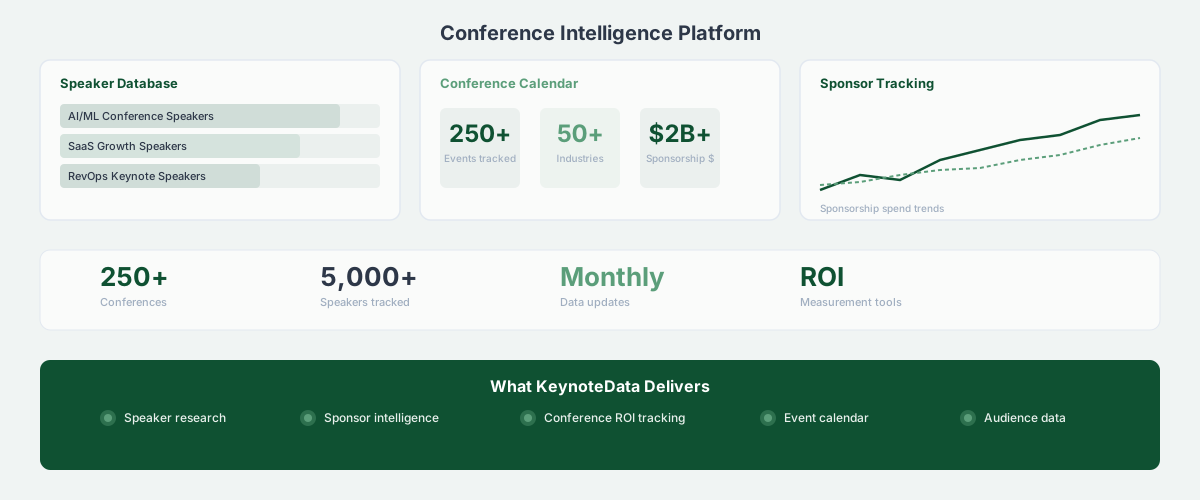
KeynoteData's speaker database lets you run this analysis across 13 B2B conferences in minutes instead of pulling rosters manually from each event site.
Filter 2: Speaker seniority distribution. Categorize the speakers by level. A conference where 50% of speakers are C-suite and VP attracts a senior audience. A conference where 70% are Directors and Managers attracts a more practitioner-level crowd. Neither is wrong. The question is which matches your buyer.
Filter 3: Sponsor composition. Look at who's sponsoring. If your competitors sponsor the event, your ICP is likely in the room. If companies adjacent to your category sponsor year after year, they've validated that the audience has budget for solutions like yours. Use our sponsor intelligence tool to see repeat sponsors across events.
Filter 4: Session topic alignment. Read the session titles and descriptions. Count how many sessions directly address the problem your product solves. A conference with 5+ relevant sessions means the audience is actively thinking about your category. They're warmer than any outbound list because they chose to attend content about your space.
Filter 5: Logistics and cost efficiency. Factor in total cost (sponsorship or ticket + travel + time) divided by expected meetings. A $50,000 event in San Francisco with 20 expected meetings costs $2,500 per meeting. A $15,000 event in Austin with 12 expected meetings costs $1,250 per meeting. The cheaper event might deliver better ROI even if it's smaller. See our sponsorship cost guide for benchmarks.
Create a simple spreadsheet with each conference as a row and each filter as a column. Score each filter 1-5. Weight them based on your priorities. Here's a starting framework:
Run the numbers. The conferences that score highest are your best bets. This doesn't replace judgment, but it replaces gut feel with structured analysis.
Suppose you sell an ABM platform to VP-level marketers at B2B SaaS companies with 200-2,000 employees. Here's how the framework plays out across five events.
SaaStr Annual. Speaker roster shows 12 of your top 100 target accounts represented. Seniority skews VP+ (strong match). Multiple ABM-adjacent sponsors (6sense, Demandbase). Several sessions on pipeline and GTM strategy. Cost: $45,000 total for a mid-tier sponsorship. Score: high.
INBOUND. Speaker roster shows 8 target accounts. Seniority is mixed, heavy on Director and Manager. Broad sponsor base. Sessions cover wide marketing topics but fewer specifically on ABM. Cost: $55,000. Score: medium-high.
Dreamforce. Speaker roster shows 5 target accounts, but the event is massive and skews enterprise. Seniority is heavy C-suite but at larger companies than your ICP. Very expensive: $80,000+. Score: medium-low for this specific ICP.
SaaStock. Speaker roster shows 6 target accounts, mostly European SaaS companies. Seniority is strong (VP+ focus). Small event, high meeting density. Cost: $25,000. Score: high if you sell into EMEA.
LeadsCon. Speaker roster shows 2 target accounts. Seniority skews Director and Manager. Session topics lean toward lead gen and performance marketing, not ABM. Cost: $20,000. Score: low for this ICP.
The framework just saved you from wasting $20,000 on LeadsCon and $80,000 on Dreamforce, and pointed you toward SaaStr Annual and SaaStock as your best investments.
Your competitors' conference choices tell you something. If three of your direct competitors sponsor an event and none of them sponsor another, there's a reason. They've tested and measured. You can learn from their bets without paying their tuition.
But don't blindly follow competitors. Sometimes a competitor sponsors an event for brand reasons, not pipeline reasons. Sometimes they're locked into a multi-year deal they'd exit if they could. Use competitive presence as one signal, not the only signal.
The more interesting play is finding events your competitors skip. If you can identify a conference where your ICP congregates but your competitors aren't present, you get a less noisy environment. Fewer competing messages means your conversations go further. Track sponsor patterns to find these gaps.
Horizontal conferences serve a function across industries. INBOUND serves marketers regardless of what they market. SaaStr Annual serves SaaS operators regardless of their vertical. These events are good for broad reach and cross-industry learning.
Vertical conferences serve a specific industry. Healthcare IT conferences, fintech summits, and construction technology events attract a narrower but more targeted audience.
If your product is industry-agnostic, prioritize horizontal events where your functional buyer attends. If you sell to a specific vertical, the vertical conference almost always delivers a higher conversion rate per attendee because the audience is pre-qualified by industry.
The best conference calendars include both: 1-2 horizontal events for broad pipeline and brand, plus 1-2 vertical events for deep, high-conversion engagement.
Don't allocate more than 20% of your conference budget to unproven events. But you should always be testing at least one new conference per year. Markets shift, new events emerge, and the conference that didn't exist two years ago might be the best event for your ICP today.
For new events, attend before you sponsor. Send 1-2 people, run pre-event outreach, book meetings, and evaluate the audience firsthand. If the event delivers, sponsor the following year. If it doesn't, you've spent $5,000-$8,000 on travel and tickets instead of $30,000-$50,000 on a sponsorship that misses.
Here's a practical process for planning your 2026 conference year:
January-February: Run the scoring framework against 10-15 candidate events. Narrow to your top 5-7. Commit to sponsoring 1-2 anchor events early (you'll get the best pricing and booth placement).
March-April: Finalize your attend-only list. Begin pre-event outreach for Q2 conferences. Start booking meetings for spring events.
After each event: Run a debrief within one week. Track meetings booked, pipeline created, and cost per meeting. Update your scoring matrix with actual performance data.
October-November: Review the full year's conference performance. Identify which events to renew, which to drop, and which new events to test next year. Lock in early-bird commitments for 2027.
Over two to three years, this process builds a conference portfolio that improves every cycle. You stop guessing and start compounding institutional knowledge about which rooms have your buyers in them.
The best conference attendees aren't the teams with the biggest budgets. They're the teams that pick the right events, prepare for them seriously, and learn from each one. The selection decision is where the entire ROI chain starts. Get it right and everything else gets easier. Get it wrong and no amount of booth design or follow-up will fix it.
Explore the full conference directory to start comparing events against your ICP, or use the speaker database to run target account overlap analysis today.
A preview of what's in the database.
| Name | Title | Company | Level | Conference(s) | |
|---|---|---|---|---|---|
| Dario Amodei | Co-Founder & CEO | Anthropic | C-Level | INBOUND,Dreamforce | LinkedIn ↗ |
| Mati Staniszewski | Co-Founder & CEO | ElevenLabs | C-Level | INBOUND,Dreamforce | LinkedIn ↗ |
| Yamini Rangan | CEO | HubSpot | C-Level | INBOUND,SaaStr Annual | LinkedIn ↗ |
| Kerry Cunningham | Head of Research & Thought Leadership | 6sense | Head of | INBOUND,6sense Breakthrough | LinkedIn ↗ |
| Olivier Godement | Head of Platform | OpenAI | Head of | INBOUND,Dreamforce | LinkedIn ↗ |
| Aaron Levie | CEO | Box | C-Level | SaaStr Annual | LinkedIn ↗ |
Showing 6 of 887 speakers. Get full access to filter and export.
Full speaker and sponsor data available for these conferences.
887 speakers, 487 sponsors, 13 conferences. Filter, search, and export.