Conference sponsor lists are one of the most underused data sources in B2B marketing. They're public, they're updated annually, and they tell you exactly which companies are betting real money on reaching a specific audience. Most marketers glance at the sponsor logos on a conference homepage and move on. The smart ones track those logos across events and over time.
When a company sponsors a B2B conference, they're making a statement. They're saying: "The people who attend this event are our buyers, and we're willing to spend $10,000-$100,000 to be in front of them."
That's useful information for anyone in the B2B ecosystem. Whether you're a marketer deciding where to spend your own event budget, a salesperson looking for companies with active growth initiatives, or a product marketer doing competitive analysis, sponsor data is a signal worth tracking.
Here's what sponsor lists actually tell you:
A company that sponsors a conference once might be testing. A company that sponsors the same conference three years in a row is getting results.
Repeat sponsorship is the strongest signal that an event delivers ROI. No marketing team keeps writing $20,000+ checks without pipeline to show for it. When you see a company return to the same event year after year, they've found something that works.
This matters for two reasons:
For event selection: If 5+ sponsors have been at an event for 3+ consecutive years, the conference has proven value for companies that sell to its audience. If those sponsors are in your category or sell to the same buyer, the event likely works for you too. Our sponsorship ROI analysis goes deeper on using repeat rates to evaluate events.
For competitive intelligence: If a competitor drops off a conference's sponsor list, that's a signal too. They either found a better channel, they're cutting spend, or the event stopped working for them. All of those possibilities are worth investigating.
Most B2B marketers don't track sponsors systematically. They check sponsor pages one at a time, right before a budget decision. That's like checking your competitor's website once a year and calling it competitive analysis.
Here's how to build a system that actually works:
List every conference that's relevant to your space. For B2B SaaS, this might be 15-25 events. Include the obvious ones (INBOUND, SaaStr Annual, Dreamforce) plus the niche events specific to your category (MozCon for SEO, LeadsCon for demand gen, 6sense Breakthrough for ABM).
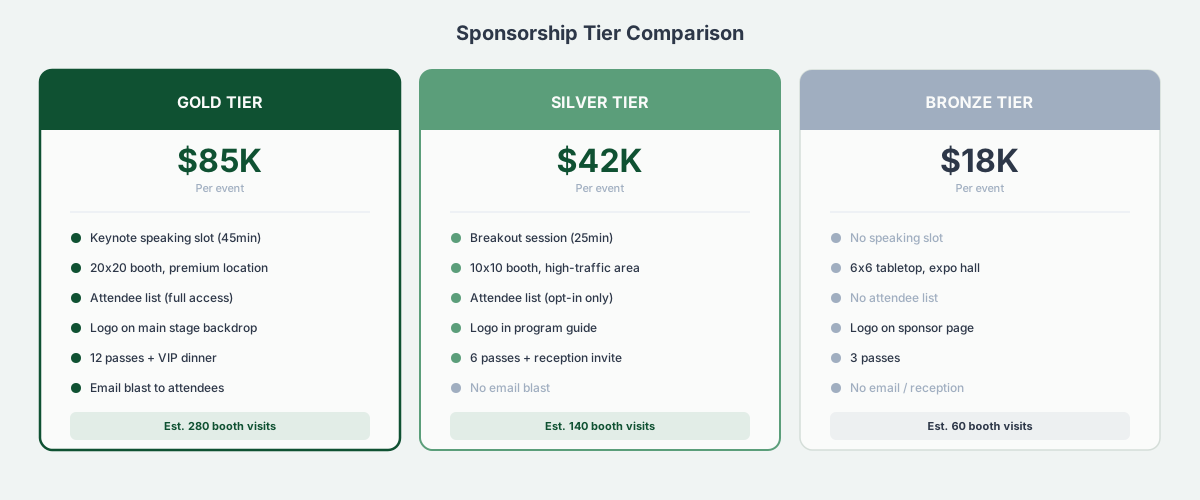
Conference websites typically update their sponsor pages 2-4 months before the event and take them down a few months after. Capture the sponsor list while it's live. Note the company name and tier (Platinum, Gold, Silver, etc.). Tier data tells you who's spending the most.
If you miss the window, the Wayback Machine sometimes captures sponsor pages. But it's unreliable. Better to capture proactively.
The real value comes when you compare across events. Build a simple spreadsheet with conferences as columns and companies as rows. Mark which companies sponsor which events. Patterns jump out immediately.
You'll see clusters: companies that sponsor every sales conference. Companies that hit every marketing event. Companies that only do the mega-events. Each pattern tells a story about that company's go-to-market strategy.
Add a time dimension. Who's new this year? Who dropped off? Who upgraded from Silver to Platinum? These movements are signals:
Your competitors' conference sponsorship choices are a window into their go-to-market strategy. Unlike most competitive intelligence, this data is completely public. You don't need any special tools to find it. You just need to look.
Map your competitive landscape. Take your top 10 competitors and list every conference they've sponsored in the past two years. This creates a competitive event map. Where do they overlap? Where do they diverge? If three competitors all sponsor an event you've been ignoring, that's worth investigating.
Spot new market moves. When a competitor sponsors a conference in a new category, they're likely expanding into that market. A CRM company suddenly sponsoring HR tech conferences? They're probably building an HR module. The sponsor list told you months before the press release.
Find gaps. Look for conferences where your ICP is well-represented but your competitors aren't. Those are underserved events where your sponsorship would stand out. Less noise, more attention. KeynoteData's sponsor database makes this analysis faster by showing you sponsor presence across 13 events.
This isn't just a marketing exercise. Sales teams can use sponsor data too.
Conference sponsors are high-intent accounts. A company that just spent $15,000 to sponsor SaaStr Annual is actively investing in growth. If you sell marketing services, sales tools, or anything that helps B2B companies grow, the sponsor list at a major conference is a warm prospect list.
Timing matters. The best time to reach out to a conference sponsor is 2-4 weeks after the event. They've just invested in growth, they're processing new contacts, and they're evaluating what worked. Your outreach fits naturally into their post-event review cycle.
Use the sponsorship as a conversation starter. "I noticed your team sponsored INBOUND this year. How did it go?" is a genuine, non-sleazy way to start a conversation. It shows you're paying attention to their business, not just blasting a list.
Doing this manually works for 5-10 conferences. If you're tracking 20+ events across multiple years, it gets tedious. That's where structured data helps.
KeynoteData tracks 487 sponsors across 13 B2B conferences. For each sponsor, we capture the company name, sponsorship tier, and which conferences they sponsor. You can filter by conference, find cross-event sponsors, and export the data for your own analysis.
The alternative is visiting 13 conference websites, copying sponsor logos into a spreadsheet, and doing the cross-referencing yourself. It takes about 4-6 hours per quarter. That's doable, but it's the kind of work that stops getting done after the first quarter.
A few limitations worth acknowledging.
Sponsor lists don't tell you ROI. Just because a company sponsors an event doesn't mean they're profitable doing it. Some companies sponsor events for brand reasons, or because an executive likes attending, or out of pure inertia. Repeat sponsorship is a stronger signal than single-year sponsorship, but it's still not proof of ROI.
Small companies are underrepresented. Sponsorship costs money. Early-stage startups can't afford $20K conference sponsorships, even if the audience is perfect. The absence of a company from sponsor lists doesn't mean the conference isn't relevant to them.
Tier data is inconsistent. Every conference names its tiers differently. One event's "Gold" might be equivalent to another event's "Presenting." Direct tier comparisons across events are unreliable. Focus on presence/absence and year-over-year changes instead.
Here's a practical cadence for sponsor tracking:
Quarterly: Pull sponsor lists for all upcoming conferences in the next 90 days. Note new sponsors, returning sponsors, and any competitors that appeared or disappeared. Update your competitive event map.
Before each budget cycle: Review the full year's sponsor data. Which events had the highest concentration of your ICP's companies? Which had the most repeat sponsors (signal of consistent ROI)? Use this to inform next year's conference marketing strategy.
After each event you attend: Compare what you saw on the ground with what the sponsor data predicted. Were the sponsors you expected actually there? Did the audience match the profile suggested by the sponsor mix? This calibrates your model over time.
Sponsor data is free. It's public. And it tells you where money is flowing in your industry. The companies that track it have an edge over the ones that don't. Most companies don't.
A preview of what's in the database.
| Name | Title | Company | Level | Conference(s) | |
|---|---|---|---|---|---|
| Dario Amodei | Co-Founder & CEO | Anthropic | C-Level | INBOUND,Dreamforce | LinkedIn ↗ |
| Mati Staniszewski | Co-Founder & CEO | ElevenLabs | C-Level | INBOUND,Dreamforce | LinkedIn ↗ |
| Yamini Rangan | CEO | HubSpot | C-Level | INBOUND,SaaStr Annual | LinkedIn ↗ |
| Kerry Cunningham | Head of Research & Thought Leadership | 6sense | Head of | INBOUND,6sense Breakthrough | LinkedIn ↗ |
| Olivier Godement | Head of Platform | OpenAI | Head of | INBOUND,Dreamforce | LinkedIn ↗ |
| Aaron Levie | CEO | Box | C-Level | SaaStr Annual | LinkedIn ↗ |
Showing 6 of 887 speakers. Get full access to filter and export.
Full speaker and sponsor data available for these conferences.
887 speakers, 487 sponsors, 13 conferences. Filter, search, and export.